

Almost every service call starts with the same sentence. "I don't know if this is worth fixing."
It is a fair question and a hard one to answer from the driveway, because the honest answer depends less on how old the door looks and more on what specifically failed. A twenty-year-old door with a snapped spring is usually a repair. A nine-year-old door with a folded panel and a bent strut can be a replacement. Age is the first thing homeowners reach for and close to the last thing that actually settles it.
Here is how the decision gets made when someone who does this for a living is standing in your garage.
Start with what broke, not with the year on the door
A garage door is not one product. It is a door, a set of springs, a track system, an opener, and about a hundred small parts that wear at different rates. When people say "my garage door broke," they almost always mean one of those systems failed while the rest are fine.
So the first job is separating the failure from the door.
Springs are the clearest example. A torsion spring has a working life measured in cycles, not years, and when it reaches the end of it the spring breaks. That is the spring doing exactly what it was built to do. It says nothing about whether the door panels above it are still good. Replacing the spring on a sound door is routine work, and on most homes it is the right call.
The same logic covers cables, rollers, hinges, bearings, weather seal, and the opener itself. These are wear parts. They are meant to be replaced during the life of the door, and replacing one is not a sign the whole system is finished.
The failures that usually stay repairs
If what went wrong is on this list, replacement is rarely the answer on its own:
- A broken spring. The loudest, most alarming failure and one of the most routine fixes.
- Frayed or snapped cables. Related to spring condition and usually addressed at the same time.
- Noisy or wobbling rollers. Worn rollers are a wear item and a cheap source of a lot of noise.
- A door that reverses when it should not. Usually the photo eyes are misaligned or dirty, or the opener travel and force settings have drifted.
- An opener that has stopped responding. The opener is a separate machine bolted to your ceiling. It can be replaced without touching the door.
- Sagging or binding at one section. Often hinges, a loose bracket, or a track alignment problem rather than a failed door.
None of that means "do nothing else." A door that has broken three springs in a short span is telling you something about how it was set up. But the repair itself is the correct starting point.
The findings that genuinely point to replacement
Now the other side. These are the ones where we will tell you a repair is money you will spend twice.
Structural damage to the panels. A door that has been backed into, or has taken a hit hard enough to fold a panel and bend the strut behind it, has lost its rigidity. Panels can sometimes be replaced individually, and on a newer door from a current product line that is worth checking. On an older door it often is not, for the reason in the next point.
Parts that no longer exist. Door lines get discontinued. When a manufacturer stops making the section, the hardware, or the matching panel profile, you can end up with a functional door you cannot properly repair. A door that cannot be sourced is a door on a clock, whatever condition it is in today.
Rust working up from the bottom. In this part of Pennsylvania, the bottom section takes the worst of it. Road salt, meltwater, and a bottom seal that stopped sealing years ago will eat a steel section from the inside out. Surface rust is cosmetic. Rust that has gone through and is flaking around the bottom bracket area is structural, and the bottom bracket is under spring tension.
Several systems failing at once. One worn system is maintenance. When the springs are at the end of their life, the rollers are shot, the track is out of alignment, and the opener is straining to lift it, you are not looking at a repair list. You are looking at a door that has reached the end of its service life all at once.
A door that was wrong for the opening from the start. We see this more than people expect. A door specified without accounting for the headroom, or a track radius that never suited the opening, will fight the building for its entire life. No amount of repair fixes a specification problem.
The option most homeowners do not know they have
There is a middle path between patching and replacing, and it is the one that saves people the most money.
Often the door itself is perfectly sound and the mechanism underneath it is the problem. In that case you are not choosing between a repair and a new door. You are upgrading the system that moves the door you already own.
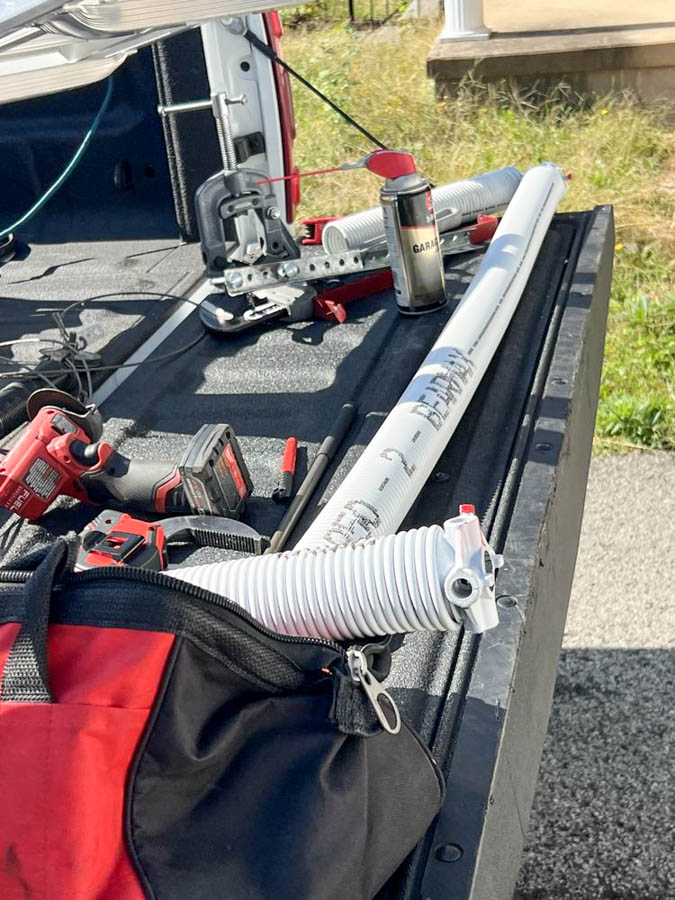
That is exactly what a torsion conversion does. Extension springs, the kind that stretch along the horizontal tracks, are an older approach that puts the load in a less forgiving place. Converting to a torsion system above the opening changes how the door is balanced and how the load is carried. Our BEARMAX torsion spring conversions exist for this situation, where the door is worth keeping and the mechanism is worth improving.
The same thinking applies to the opener. A new opener on a sound door is a straightforward upgrade, and it is frequently what someone actually needs when they tell us the door is "getting old."
The three questions that settle a borderline case
When it is genuinely close, these are what we work through with the homeowner.
Is it safe in its current state? This is not a judgment call we soften. A garage door is the heaviest moving object in most homes, and springs store a lot of energy. If the failure involves the springs, cables, or bottom brackets, the safety answer comes before the economic one.
Can it be properly repaired, not just made to work? There is a difference between a door that has been fixed and a door that has been persuaded. If the only way to get it moving involves working around a problem rather than correcting it, that is a replacement conversation.
Does the door still suit the house and how you use it? Sometimes the honest answer has nothing to do with failure. If the garage has become a workshop, or the door faces the street on a house you are about to sell, or it has never been insulated and now sits against a converted room, the decision is about what you need rather than what broke.
What a real diagnosis looks like
You cannot answer any of this properly from a photo, and we will not pretend otherwise over the phone.
What actually happens is an inspection: the door gets balance-tested, the springs and cables get examined for wear and correct sizing, the track alignment gets checked, the opener force and safety reversal get tested, and the hardware gets gone over. Our annual 122-Point Tune-Up is the thorough version of that same process for a door that is still healthy and you want to keep that way.
Service calls and inspections carry a standard $79 Diagnostic Assessment, and it is waived if you move forward with the work. We mention that plainly because a paid diagnosis is usually the honest one. Nobody inspecting your door for nothing has a reason to tell you it is fine.
Pricing after that is up-front. No hidden fees, no shop-supplies charges, no junk add-ons, and you get the number before any work begins.
What we tell people when it is close
Fix the thing that broke, then watch how the door behaves for a season.
A door that runs quietly and evenly after a spring replacement was a door with a broken spring. A door that develops a new complaint two months later was telling you something bigger, and now you have real information instead of a guess. The only case where we do not give that advice is when the safety answer already decided it.
Frequently asked questions
Does a broken spring mean I need a new garage door?
Usually not. Springs are wear parts with a life measured in cycles. A broken spring on a structurally sound door is one of the most routine repairs there is.
My door is over twenty years old. Is it automatically time to replace it?
No. Age matters less than condition, parts availability, and whether multiple systems are failing together. Plenty of older doors are worth keeping, and some much newer ones are not.
Can you replace just one damaged panel?
Sometimes. It depends on whether the section is still manufactured and whether the damage extended into the hardware behind it. On a current product line it is worth checking. On a discontinued door it often is not possible.
Is it worth repairing a door with rust at the bottom?
It depends how far the rust has gone. Surface rust on the skin is cosmetic. Rust that has perforated the section around the bottom bracket area is structural, and that bracket is under spring tension, so it gets treated seriously.
What is a torsion conversion, and why would I want one?
It replaces an extension spring setup with a torsion system mounted above the door opening, changing how the door is balanced and how its weight is carried. It is often the right answer when the door is sound but the mechanism moving it is not.
Should I try replacing a spring myself?
No. Torsion springs hold a large amount of stored energy even when the door is down, and the tools and technique matter. This is the repair where the consequences of getting it wrong are serious injuries.
How do I know a contractor is not just selling me a door?
Ask them to show you the specific finding that rules out a repair. A real diagnosis names the failed part and explains why it cannot be corrected. "It is old" is not a finding.
Get a straight answer about your door
Bear Door Services is owner-operated by Michael, an IDEA Certified professional with an Electromechanical degree and over 14 years in the trade, working under Pennsylvania license PA195086. More than 220 Google reviews at a 5.0 average.
Labor on most repairs and installs is guaranteed for at least a year. Premium installs carry up to 10 years on parts and labor, door finishes carry a lifetime warranty, and premium parts bring their own manufacturer coverage. Financing is available on jobs from $500 up to $25,000.
We serve Uniontown and the surrounding area, including Brownsville, Connellsville, East Uniontown, Fairchance, Hopwood, Masontown, Oliver, Smithfield, South Union Township, Washington, and Morgantown and Cheat Lake in West Virginia.
Call (724) 429-1395 or request a quote, and we will tell you what your door actually needs.